Featured Post

CURSOS DE IDIOMAS GLOBO - Review

16 de março de 2014

LEVEL 5 - END OF EXPERIMENT - FIM DO EXPERIMENTO


(Watch in youtube for subtitles.) 
(Assista no youtube e veja as legendas.)


Texto em Português mais abaixo  
Scroll down for text in Portuguese

LEVEL CONCLUDED: 5
TYPE OF CURRICULUM: standard
OVERALL SCORE: 97%
TIME SPENT: 22.5 hours
Starting date: Feb 27, 2014
Finishing date: March 9, 2014.
Number of days of study: 10 days
Content review: 8 hours (March 10-12)
Total number of hours to complete all 5 levels (reviews included): 130 hours


CAN WE SPEAK A LANGUAGE FLUENTLY WITH ROSETTA STONE?

Finally, after five months of hard studying I have completed all the five levels of Rosetta Stone! So, the ultimate answer everyone is waiting for and the question highlighted on the heading of this blog, which is the purpose of my challenge: DID I SUCCEED LEARNING TO SPEAK FLUENT ITALIAN WITH ROSETTA STONE? And here is the most awaited answer in this blog… for the contentment of some people and disappointment of others… my answer is: NO! I still don’t speak fluent Italian, at least in my point of view, I’d have to say no.  Of course first we’d have to define what is meant by “fluency”, because this term can mean different things for different people. If fluency means to have a native-like language skill, then absolutely I don’t speak Italian fluently. But if fluency means to have enough language knowledge to at least be able to express my thoughts (even making many mistakes and stopping a lot trying to remember words), then yes, I can say I’m not so far from this concept of fluency. So if people ask me: CAN WE SPEAK A LANGUAGE FLUENTLY WITH ROSETTA STONE? I’d have to answer: NO, BUT WE CAN START TO SPEAK FLUENTLY.


DOES ROSETTA STONE WORK?

When asked this question, many people say a clear and sounding NO, Rosetta Stone doesn’t work. But I have to say YES, it works. In fact I believe it doesn’t work for everybody since there are different kinds of learners. But for me, it worked. But what do I mean by that?

Perhaps the advertisement made around Rosetta Stone can make people believe they will learn the language fluently and go around speaking in any situation with anyone at will just by using the program. However, in the official website, they claim that, after finishing the program, we can reach into, but not necessarily master, level B1, and Rosetta Stone opens the door to level B2 of the CEFR.
http://resources.rosettastone.com/CDN/uk/pdfs/CEFR.pdf

So I think they were honest with this assessment. My test results show that I have reached that level only by using the software. So if people ask me: DOES ROSETTA STONE WORK? I have to say YES, it works. The program does what it claims to do, at least for some learners.


TEST RESULTS


Test Level
Results after completing LEVEL 3
Results after completing LEVEL 4
Results after completing LEVEL 5
A1 (basic user 1)
83%
90%
90%
A2 (basic user 2)
83%
83%
83%
B1 (independent user 1)
57%
63%
73%
B2 (independent user 2)
-
53%
70%


WHEN DID I NOTICE I REALLY COULD SPEAK SOMETHING?

I confess I was a little disappointed and discouraged after finishing level 4. As I said before, I couldn’t feel much improvement comparing to the end of level 3. But soon after I started level 5, let’s say, after some lessons, the words simply started popping up in my head without making that much effort I had to make before, it was magic! For example, I took a trip with my grandmother (not to Italy, unfortunately, but to a neighbor city right here in Brazil), and when we arrived in our destination, I was watching her unpacking her luggage and the sentence in Italian just popped up in my head almost unconsciously: “Mia nonna disfa la valigia.” Then the magic started. I went to the bathroom and I realized I could name many things there: la doccia, il gabinetto, il lavandino, il sapone, uno spazzolino, un dentifricio... (the shower, the toilet, the sink, the soap, a toothbrush, a toothpaste). And then I was able to make sentences to describe what I was doing: Io farò la doccia e mi laverò i denti (I will take a shower and brush my teeth).

Frequently, when I’m about to sleep, I have noticed that many words and sentences I saw in the course, but which are difficult to remember, come to my head randomly and unconsciously: Lui ha la faccia gonfia (He has a swollen face). Prenda questo sentiero e vada dritto (Take this trail and go ahead)… I was very surprised – these weren’t things I decided to remember, they simply came to my mind. Of course there are many words that I know I learned in the course but which I can’t remember or about which I’m not so sure.


MY SPEAKING SKILL

I feel that I speak some Italian and with some effort I can express my thoughts. I guess I make many mistakes and I have to stop and think on the words. And there are many words I would need to express myself more precisely but I haven’t learned on the course.

If I went to Italy today, I guess I wouldn’t have major problems using the language as a tourist. The problems would come in having a more complex conversation with someone about a specific topic. I feel that I still wouldn’t be able to have a philosophical debate at a bar, for instance, nor defend my ideas in a discussion, but I sure could express more general points.

I’m not fluent yet, but I’m starting to be fluent. Now that I really speak Italian in a more consistent way than just a basic learner, I have noticed a problem. My first language is Portuguese, and I have also studied Spanish and Esperanto – this can be a great advantage in learning new languages. But because these languages share so much in common, I unconsciously mix up words from Portuguese, Spanish and Esperanto when I speak Italian (I just realize after I speak or when I listen to my voice recorded). When I think in Italian, sometimes the first thing that comes to my mind is Esperanto.


MY COMPREHENSION

I have a very good comprehension of formal Italian (we also have to consider that my first language is Portuguese, which also has a Latin origin like Italian). I am able to watch and understand the news and documentaries at ease. I tried watching some movies with more slangs and colloquialisms but I gave up in the beginning because I couldn’t understand much. However, I did better watching an episode of an Italian series that has a more formal language (in youtube: Sissi, fiction Rai - parte 1).
I tried reading some literature, but gave up. However, I can read well more scientific articles, like the ones of Wikipedia.


HOW LONG TO FINISH THE COURSE?

That depends on the curriculum you choose. For the standard curriculum, it took me around 20-25 hours to finish each level. It took me around 130 hours to study all levels (reviews included).


HOW CAN WE USE THIS KNOWLEDGE?

The knowledge you can obtain with the software may be enough or not depending on your purpose with the language. It may not be enough if you want to read literature or watch movies, have a complex discussion and defend all your ideas, and use the language professionally. There’s no need to mention you will be far from having the ability to work as a translator or a teacher of the language. It would be possible but difficult to use the language in business meetings or give a speech in a conference, for example.

This knowledge can be enough if you are going to be a tourist in a foreign country, if you are going to have informal contact with foreigners or people that speak the language, or if you just want to read scientific articles in your area. You can also watch the news and documentaries or take part in a conference as a listener.


FINAL CONCLUSION OF MY EXPERIMENT


CAN WE SPEAK A LANGUAGE FLUENTLY WITH ROSETTA STONE? – No, but we can START to speak fluently. You would be able to watch the news, documentaries, read scientific articles, express most of your thoughts in a simple way and in general terms and use the language well as a tourist or in other simple social interactions. It would be difficult to watch movies, read literature, give a speech or engage in a complex discussion.

DOES ROSETTA STONE WORK? – Yes. Maybe not for everybody, but for some learners it may bring good results. Rosetta Stone developers claim we can achieve level B1 or B2 upon finishing the course. I believe they were honest because my test results confirm that.


_______________________________________________________________


NÍVEL CONCLUÍDO: 5
TIPO DE CURRÍCULO: standard
PONTUAÇÃO GERAL: 97%
TEMPO GASTO: 22.5 horas
Data de início: 27 de fev, 2014
Data de término: 09 de março, 2014
Número de dias de estudo: 10 dias
Revisão do conteúdo: 8 horas (10-12 de março)
Total de horas para completar todos os 5 níveis (revisões incluídas): 130 horas


PODEMOS FALAR UMA LÍNGUA FLUENTEMENTE COM ROSETTA STONE?

Finalmente, depois de cinco meses estudando muito, terminei todos os cinco níveis do Rosetta Stone! Então, a resposta final que todos estão esperando e a pergunta destacada no cabeçalho deste blog, que é o propósito do meu desafio: EU OBTIVE  SUCESSO EM APRENDER A FALAR ITALIANO FLUENTEMENTE COM O ROSETTA STONE? E a resposta mais esperada deste blog... para o contentamento de uns e desapontamento de outros... a resposta é: NÃO! Eu ainda não falo italiano fluente, pelo menos no meu ponto de vista, eu tenho que dizer não. Claro que primeiro devemos definir o que se quer dizer com “fluência”, porque esse termo pode ter significados diferentes para cada pessoa. Se fluência significa ter a habilidade parecida com a de um falante nativo, então absolutamente eu não falo italiano fluente. Mas se fluência significa ter um conhecimento da língua suficiente para pelo menos conseguir expressar meus pensamentos (mesmo cometendo vários erros e parando para me lembrar das palavras), então sim, eu posso dizer que não estou muito longe desse conceito de fluência. Então se alguém me perguntar: PODEMOS FALAR UMA LÍNGUA FLUENTEMENTE COM O ROSETTA STONE? Eu teria de responder: NÃO, MAS PODEMOS COMEÇAR A FALAR FLUENTEMENTE.


O ROSETTA STONE FUNCIONA?

Muitas pessoas dizem um claro NÃO, o Rosetta Stone não funciona. Mas eu tenho que dizer SIM, funciona. Na verdade, acredito que não funciona para todos já que as pessoas aprendem de forma diferente. Mas para mim funcionou. Mas o que quero dizer com isso?

Talvez toda a propaganda em torno do curso leve as pessoas a acreditarem que elas vão aprender a língua fluentemente e sair por aí falando a torto e direito em qualquer situação com qualquer pessoa à vontade depois de usar o programa. No entanto, no site oficial, eles afirmam que ao completar o curso podemos alcançar, mas não necessariamente dominar, o nível B1, e Rosetta Stone abre a porta para o nível B2 do CEFR.
http://resources.rosettastone.com/CDN/uk/pdfs/CEFR.pdf

Acredito que eles tenham sido honestos nessa avaliação. Os resultados dos meus testes mostram que eu alcancei esse nível somente usando o programa. Então se as pessoas me perguntarem: O ROSETTA STONE FUNCIONA? Eu tenho que dizer SIM, funciona. O programa faz o que promete, pelo menos para alguns estudantes.


RESULTADOS DOS TESTES


Nível do teste
Resultados depois de completar o NÍVEL 3
Resultados depois de completar o NÍVEL 4
Resultados depois de completar o NÍVEL 5
A1 (usuário básico 1)
83%
90%
90%
A2 (usuário básico 2)
83%
83%
83%
B1 (usuário independente 1)
57%
63%
73%
B2 (usuário independente  2)
-
53%
70%


QUANDO EU PERCEBI QUE EU REALMENTE PODIA FALAR ALGO?

Confesso que me senti um pouco desapontado e desanimado depois que terminei o nível 4. Como disse antes, não consegui sentir um avanço significativo comparando com a conclusão do nível 3. Mas logo após começar o nível 5, digamos, depois de algumas lições, as palavras simplesmente começaram a pipocar na minha cabeça sem eu precisar fazer todo o esforço que eu fazia antes, foi mágico! Por exemplo, eu viajei com minha avó (não para a Itália, infelizmente, mas para uma cidade vizinha), e quando chegamos no nosso destino, eu estava vendo ela tirar as coisas da mala, e uma frase simplesmente passou pela minha cabeça sem eu nem querer pensar nela: “Mia nonna disfa la valigia.” É como se tivesse irrompido do meu inconsciente! Então a mágica começou! Eu fui ao banheiro e percebi que podia dar nome a muitas coisas lá: la doccia, il gabinetto, il lavandino, il sapone, uno spazzolino, un dentifricio... (o chuveiro, o vaso, a pia, o sabonete, uma escova, uma pasta de dente). E então eu conseguia formular frases para descrever o que eu estava fazendo: Io farò la doccia e mi laverò i denti (Vou tomar banho e escovar os dentes).

Frequentemente à noite já na cama, quando estou naquele estado meio-dormindo-meio-acordado, percebi que muitas palavras e frases que eu vi no curso, mas que são difíceis de lembrar, surgem na minha cabeça de forma aleatória e inconsciente: : Lui ha la faccia gonfia (Ele está com o rosto inchado). Prenda questo sentiero e vada dritto (Pegue este caminho e siga reto)… Fiquei muito surpreso – não foram palavras que eu decidi lembrar, elas simplesmente vieram à minha mente. Claro que há muitas palavras que eu sei que vi no curso mas que não consigo me lembrar ou das quais não estou muito certo.


MINHA HABILIDADE DE FALAR

Eu sinto que falo um pouco de Italiano e com algum esforço eu consigo expressar meus pensamentos. Acho que cometo muitos erros e tenho que parar e pensar nas palavras. E há muitas palavras que eu precisaria para conseguir me expressar com mais precisão mas que eu não aprendi no curso.

Se eu fosse para a Itália hoje, acredito que não teria grandes problemas ao usar a língua como um turista. Os problemas surgiriam ao tentar uma conversa mais complexa sobre um tema muito específico. Ainda sinto que não conseguiria ter um debate filosófico num bar, por exemplo, nem defender minhas ideias numa discussão, mas certamente eu consigo expressar pontos mais gerais.

Ainda não estou fluente, mas estou começando a ficar fluente. Agora que realmente falo italiano de forma mais consistente do que um falante de nível básico, eu percebi um problema. Minha primeira língua é o Português, também estudei Espanhol e Esperanto – isso pode ser uma vantagem ao aprender novas línguas. Mas porque essas línguas possuem tanto em comum, eu inconscientemente misturo palavras do Português, Espanhol e Esperanto quando falo Italiano (só percebo isso depois de falar ou quando eu escuto minha fala gravada). Quando penso em Italiano, algumas vezes a primeira coisa que me vem à cabeça é o Esperanto.


MINHA COMPREENSÃO

Tenho uma compreensão muito boa do Italiano formal (também temos que considerar que minha primeira língua é o Português, que também possui uma origem latina como o Italiano). Consigo assistir e entender notícias e documentários com facilidade. Tentei assistir a filmes que possuem gírias e coloquialismos mas desisti no começo porque não consegui entender muito. No entanto, entendi melhor um episódio de uma série italiana que possui uma linguagem formal (no youtube: Sissi, fiction Rai - parte 1).
Tentei ler literatura, mas desisti. Porém, consigo ler artigos mais científicos, como os da Wikipédia.


QUANTO TEMPO PARA TERMINAR O CURSO?

Isso depende do currículo que você escolher. Para o currículo standard, eu levei de 20 a 25 horas para terminar cada nível. Levei mais ou menos 130 horas para estudar todos os níveis (incluindo as revisões).


COMO PODEMOS USAR ESSE CONHECIMENTO?

O conhecimento adquirido com o software pode ser suficiente ou não dependendo do seu objetivo com a língua. Pode não ser suficiente se você quer ler literatura ou assistir a filmes, ter discussões mais complexas, defender suas ideias e usar a língua profissionalmente. Nem precisa dizer que ao terminar o curso você estará ainda bem longe de possuir habilidade de trabalhar como um tradutor ou professor da língua.  Seria até possível, mas difícil, usar a língua em reuniões de negócio ou dar uma palestra numa conferência, por exemplo.

Esse conhecimento pode ser suficiente se você vai ser um turista em um outro país, se você terá contatos informais com estrangeiros ou pessoas que falam a língua, ou se você só quer ler artigos científicos na sua área. Você também poderá assistir às notícias e documentários ou participar de uma conferência como um ouvinte.


CONCLUSÃO FINAL DO MEU EXPERIMENTO


PODEMOS FALAR UMA LÍNGUA FLUENTEMENTE COM ROSETTA STONE? – Não, mas podemos COMEÇAR a falar fluentemente. Seria possível assistir a notícias e documentários, ler artigos científicos, expressar a maioria dos seus pensamentos de forma simples e em termos gerais e usar a língua sem grandes problemas como um turista ou em interações sociais simples. Seria difícil assistir a filmes, ler literatura, dar uma palestra ou participar de uma discussão mais complexa.

O ROSETTA STONE FUCIONA? – Sim. Talvez não para todos, mas para alguns estudantes pode trazer bons resultados. Os desenvolvedores do Rosetta Stone afirmam que podemos obter um nível B1 ou B2 ao terminar o curso. Acredito que eles tenham sido honestos porque os resultados dos meus testes confirmam isso.

26 de fevereiro de 2014

LEVEL 4 FINISHED! - NÍVEL 4 CONCLUÍDO!

[Texto em Português mais abaixo]

LEVEL CONCLUDED: 4
TYPE OF CURRICULUM: standard
OVERALL SCORE: 97%
TIME SPENT: 22 hours
Starting date: Jan 2, 2014
Finishing date: Feb 23, 2014.
Number of days of study: 14 days
Content review: 5 hours (Feb 24-25)
Total number of hours to complete the 4 levels (reviews included): 104 hours

WHAT YOU WILL LEARN IN LEVEL 4

The 16 lessons are divided into these unities:
1 - Tourism and recreation
2 - Professions and hobbies
3 - At home and around town
4 - Style and personal wellness

VOCABULARY related to: tourism, art, musical instruments, restaurant, food, sports, parts of the house, professions, nature, post office, moving, furniture, traffic, car parts, laundry, health, supermarket, etc.

GRAMMAR
A great innovation of Level 4 is that the grammar elements the learner should focus on are now highlighted with different colors. Since the proposal of Rosetta Stone method is indeed the lack of explicit grammar explanation, now at least we know where to focus our attention on. For example, if the grammar focus of a given lesson are some specific prepositions, these prepositions will be colored in either red or blue.
Some grammar points in Level 4:
- Review of many points from previous levels; comparisons of verb tenses; deeper focus on prepositions and conjunctions; combination of prepositions and articles; verb and noun agreements; reflexive and objective pronouns; etc.

SKILLS
- How to buy a ticket, understanding tourist information from a guide, going on excursions and talking about activities, talking about distances and directions;
- Talking about art, describing things like: painting, drawing, sculpting, etc. Describe works of art (using some adjectives and informing when they were made);
- Making your order at restaurants with more specific vocabulary, for example, telling how many in your party, saying if it’s “for here or to go”, talking about meats of different animals or saying that you would like vegetarian dishes;
- Talking about sports. Saying what sports you like or play, talking about a match;
- Talking about appliances that need to be turned on, turned off, that the battery is dying or charged;
- Saying that something is broken, relating a problem, saying that you need to call a plumber, an electrician, mechanic, doctor, police officer, etc.
- Talking about health problems (fever, cough, sneeze, allergies, etc.);
- Asking where you can find certain products at a supermarket, understanding the products sections;
- Understanding a recipe and giving instruction on how to prepare dishes.

PRACTICAL RESULTS OF MY STUDY
My overall impression is that I still don’t feel I can say: “I speak Italian”. However, I can sure say: “I speak some Italian”. When I try to say something I still have to think a lot before actually speaking out, and there is a lack of words to express some things I would like to say: either because I don’t remember the words I learned, or simply because I haven’t learned them in the program. The difficulty in remembering some words may be due to the fact that I'm following the "Standard" curriculum - if I followed a longer curriculum with more exercises, chances are that problem would be minimized (and the process would be more repetitive as well). Anyway, my speaking skill is still poor.

However, if I went to Italy today, I feel I would be able to handle most common situations a tourist might encounter: at the airport, hotel, restaurant, getting a bus or taxi, buying tickets, etc. So the language skills acquired in these fours levels should be enough for an average tourist.

But for those who want to handle a more complex conversation with Italian speakers, these skills are far from enough. Maybe you would be able to express your opinion about things using very simple words, and perhaps (like me) pausing a lot trying to recollect words from your memory (unless you have a very good memory). Fluency still requires a much deeper study than just what level 4 can offer.

My comprehension is naturally on the rise. I haven’t been watching things in Italian as much as I’d like to, but when I do, obviously I don’t understand all the words, but I understand almost all of what the information is about. However, I have tried to listen only to formal Italian (news and documentaries), where the language is normally clearer and easier. I haven’t tried any film or the like, where the language is informal, full of colloquialism, slangs, etc. I guess I’d be frustrated if I tried to understand that – Rosetta Stone doesn’t prepare learners to understand this kind of language. Well, I’ll watch a complete Italian movie after finishing level 5 and give my verdict.

TEST RESULTS
The test results show what I suspected: my progress wasn’t so astonishing after completing level 4.


COMPARATIVE TABLE
Test Level
Results after completing LEVEL 3
Results after completing
LEVEL 4
A1 (basic user 1)
83%
90%
A2 (basic user 1)
83%
83%
B1 (independente user 1)
57%
63%
B2 (independente user 2)
-
53%

However, I don’t know if this or other online tests are very reliable. For example, I tried other online test just to compare results, and I chose the test from a reputable institution, EF schools, and it placed me on level C1 (I got 80% right), which is obviously quite imprecise.

CONCLUSION (THE FIRST OF THE NEXT HUNDREDS)
I can confidently say I speak “some” Italian, and I could use my basic skills as a tourist, for example, but I’m still far from fluency. I could try to express more complex things, but I have to think a lot to recall the words before speaking. Although level 4 has more complex sentences and deeper grammar, I have the impression I didn’t make a notable progress comparing to the completion of level 3 (maybe I should have studied more). Well, we’ll have to wait until I finish level 5. 

Anyway, keeping in mind that learning a language well may require lots of hundreds of hours of study and practice, only ONE hundred (what I have done so far) is still the first of the next hundreds. 

______________________________________________

NÍVEL CONCLUÍDO: 4
TIPO DE CURRÍCULO: standard
PONTUAÇÃO GERAL: 97%
TEMPO GASTO: 22 horas
Data de início: 2 de jan de 2014
Data de término: 23 de fev de 2014
Número de dias de estudo: 14 dias
Revisão do conteúdo: 5 horas (24-25 fev)
Total de horas para completar o nível 4 (incluindo revisões): 104 horas

O QUE SE APRENDE NO NÍVEL 4

As 16 lições são divididas em 4 unidades:
1 – Turismo e recreação
2 – Profissões e hobbies
3 – Em casa e andando pela cidade
4 – Estilo e bem-estar pessoal

VOCABULÁRIO relacionado a: turismo, arte, instrumentos musicais, restaurante, alimentos, esportes, partes da casa, profissões, natureza, correio, mudança, móveis, tráfego, roupas, saúde, supermercado, etc.

GRAMÁTICA
Uma grande inovação do nível 4 é que os elementos gramaticais que são foco de cada lição são agora destacados com cores diferentes, de modo que podemos voltar nossa atenção a eles. Já que a proposta do método do Rosetta Stone é de fato não dar explicações gramaticais explícitas, agora pelo menos sabemos no que devemos voltar nossa atenção. Por exemplo, se o foco gramatical de uma dada lição são preposições específicas, essas preposições virão destacadas em vermelho ou azul.
Alguns pontos gramaticais do nível 4:
- Revisão de muitos pontos de níveis anteriores; comparações entre tempos verbais; maior foco nas preposições e conjunções; combinações de preposições + artigos; concordâncias verbal e nominal; pronomes reflexivos e objetos; etc.

HABILIDADES
- Como comprar um bilhete ou ingresso, entender informações turísticas, acompanhar um guia, atividades de excursão, falar de distâncias e localização;
- Falar sobre arte, descrever ações como: pintar, desenhar, fazer uma escultura, etc. Descrever obras de arte (usando alguns adjetivos e informar a época).
- Fazer pedidos num restaurante com vocabulário mais específico, por exemplo, dizer que precisa de uma mesa para um número específico de pessoas, dizer se é para comer no restaurante ou para levar, falar sobre carnes de diferentes animais ou dizer que você gostaria de pratos vegetarianos;
- Falar sobre esportes. Dizer quais esportes gosta ou pratica, falar sobre uma partida.
- Falar sobre aparelhos que precisam ser ligados, desligados, que a bateria está cheia ou acabando, etc.
- Dizer que algo está quebrado, relatar um problema, dizer que precisa chamar um encanador, eletricista, mecânico, policial, médico, etc.
- Falar sobre problemas de saúde (está com febre, tossindo, espirrando, com alergia, etc.)
- Perguntar onde se encontra determinado produto no supermercado, entender as seções de produtos,
- Entender uma receita e dar instruções para preparar alimentos.


RESULTADOS PRÁTICOS DO MEU ESTUDO
Minha impressão geral é que ainda não sinto que posso dizer: “EU FALO ITALIANO!”. Porém, posso dizer com segurança: “Eu falo UM POUCO de italiano.” Quando tendo dizer algo, ainda preciso pensar muito antes de poder realmente falar. Ainda faltam palavras para conseguir expressar ideias que eu gostaria de dizer: seja porque eu não consigo me lembrar dessas palavras, ou simplesmente porque não aprendi no programa. Talvez a dificuldade de me lembrar de algumas palavras se deva ao fato de eu estar seguindo o currículo Standard - um currículo mais longo com mais exercícios diminuiria o problema (e também tornaria todo o processo mais repetitivo). Em todo caso, minha habilidade em falar ainda não é satisfatória.

No entanto, se fu fosse para a Itália hoje, sinto que iria conseguir me virar na maioria das situações comuns que um turista poderia enfrentar: no aeroporto, hotel, restaurante, pegando ônibus ou taxi, comprando entradas, etc. Então as habilidades linguísticas adquiridas nesses quatro níveis devem ser suficientes para um turista médio.

Mas para aqueles que esperam poder manter uma conversa mais complexa com falantes de italiano, essas habilidades ainda estão longe de serem suficientes. Talvez você consiga expressar sua opinião sobre coisas usando palavras bem simples, ou talvez (como eu) tenha que ficar parando para pensar tentando resgatar as palavras da memória (a não ser que você tenha uma memória muito boa!). Alcançar a fluência ainda requer um estudo muito mais profundo, além do que o nível 4 pode oferecer.

Minha compreensão naturalmente está melhorando. Não tenho assistido a tantos vídeos em italiano como eu gostaria, mas quando assisto, obviamente não entendo cada palavra, mas entendo praticamente tudo sobre o que tratam as informações. Mas por enquanto eu só parei para ouvir o italiano formal (notícias e documentários), onde a linguagem é geralmente mais clara e fácil de entender. Ainda não me aventurei a assistir a nenhum filme ou coisa do tipo, onde a linguagem é informal, cheia de coloquialismos, gírias, etc. Acho que nesse caso eu ficaria frustrado já que o Rosetta Stone não nos prepara para entender esse tipo de linguagem. Bem, vou assistir a um filme italiano completo depois que eu terminar o nível 5 e darei meu veredito.

RESULTADO DOS TESTES
Os resultados mostram o que eu suspeitava: meu progresso não foi tão significativo depois de completar o nível 4.


TABELA COMPARATIVA
Nível do teste
Resultados depois de completar o NÍVEL 3
Resultados depois de completar o NÍVEL 4
A1 (usuário básico 1)
83%
90%
A2 (usuário básico 1)
83%
83%
B1 (usuário independente 1)
57%
63%
B2 (usuário independente 2)
-
53%

Porém, eu não sei até que ponto esses testes online são confiáveis. Por exemplo, eu tentei fazer outro teste somente para comparar esses resultados, e escolhi o teste de uma instituição renomada, as escolas EF, e o teste me colocou no nível C1 (acertei 80%) – é óbvio que esse resultado é bastante impreciso.


CONCLUSÃO (A PRIMEIRA DAS PRÓXIMAS CENTENAS)

Eu posso dizer com segurança que falo “um pouco” de italiano. Eu poderia usar minhas habilidades básicas como um turista, por exemplo, mas ainda estou longe da fluência. Eu poderia tentar expressar coisas mais complexas, mas ainda tenho que pensar muito tentando me lembrar das palavras antes de falar. Embora o nível 4 tenha frases mais complexas e um maior foco na gramática, tenho a impressão de que meu progresso não foi notável comparando com o término do nível 3 (talvez eu deveria ter estudado mais). Bem, teremos que esperar eu terminar o nível 5.

De qualquer forma, tendo em mente que para se aprender bem uma língua podem ser necessárias várias centenas de horas de estudo e prática, somente UMA centena (o que fiz até agora) é ainda a primeira das próximas centenas.

3 de janeiro de 2014

REVIEW - REVISÃO (Level 1 - 3)


Dear readers,
The end of the year was very busy for me, so I decided not to start level 4 until I had more free time. I finished level 3 on November 10 and today is January 3, but I didn't exactly take a break from Rosetta Stone for all this time. Instead of going ahead to a new level, I decided to engage in a long review.

For the review, I chose the “Listening Placement” Curriculum, since the kind of exercise in this course of study was not included in the Standard Curriculum, which is the one I was following.

These exercises consist on listening and choosing the right pictures. I also tried to repeat each sentence aloud. After choosing the correct options, the program reveals the writing, so I could read and confirm whether I repeated correctly.

It took me about 15 hours to complete this review from Level 1 to Level 3.


PRACTICAL RESULTS OF THE REVIEW

LEVELS: From 1 to 3
TYPE OF CURRICULUM: Listening Placement
TIME SPENT: 15 hours

To assess the impact this review had on my knowledge, I retook this Italian Test http://www.italian-test.com/index.htm

Here are my restults:


Test Level Results after completing Level 3 (62 hours of study) – no review Results after completing Level 3 (62 hours) + 15 hour review
A1 (basic 1) 83% 83%
A2 (basic 2) 70% 83%
B1 (intermediate 1) 40% 57%

Based on the test results, we can see that this review proved to be effective in reinforcing the knowledge I acquired with the program. 

______________________________________________________

Caros leitores,
Estive bastante ocupado no final do ano, então decidi não começar o nível 4 até ter mais tempo livre para me dedicar. Terminei o nível 3 no dia 10 de novembro e hoje já é 3 de janeiro, mas eu não tirei férias do Rosetta Stone por todo esse tempo. Em vez de prosseguir para o próximo nível, decidi fazer uma longa revisão.

Para a revisão, escolhi o Currículo “Listening Placement”, já que o tipo de exercício nesse curso não estava incluído no Currículo Standard, que era o que eu estava seguindo.

Os exercícios consistem em ouvir e escolher as figuras corretas. Eu também tentava repetir cada frase em voz alta. Depois de escolher a opção correta, o programa revela a escrita, assim eu podia ler e confirmar se repeti corretamente.

No total foram 15 horas de estudo para completar a revisão do nível 1 ao nível 3.


RESULTADOS PRÁTICOS DA REVISÃO

NÍVEIS: do 1 ao 3
TIPO DE CURRÍCULO: Listening Placement
TEMPO GASTO: 15 horas

Para avaliar o impacto que a revisão teve no meu conhecimento, refiz o Teste de Italiano:


Aqui estão meus resultados:


Nível do Teste Resultados depois de completar o Nível 3 (62 horas de estudo) – Sem revisão Resultados depois de completar o Nível 3 (62 horas) + 15 horas de revisão
A1 (básico 1) 83% 83%
A2 (básico 2) 70% 83%
B1 (intermediário 1) 40% 57%


Baseando-se nos resultados do teste, podemos ver que essa revisão provou ser efetiva em reforçar o conhecimento que adquiri com o programa.

26 de dezembro de 2013

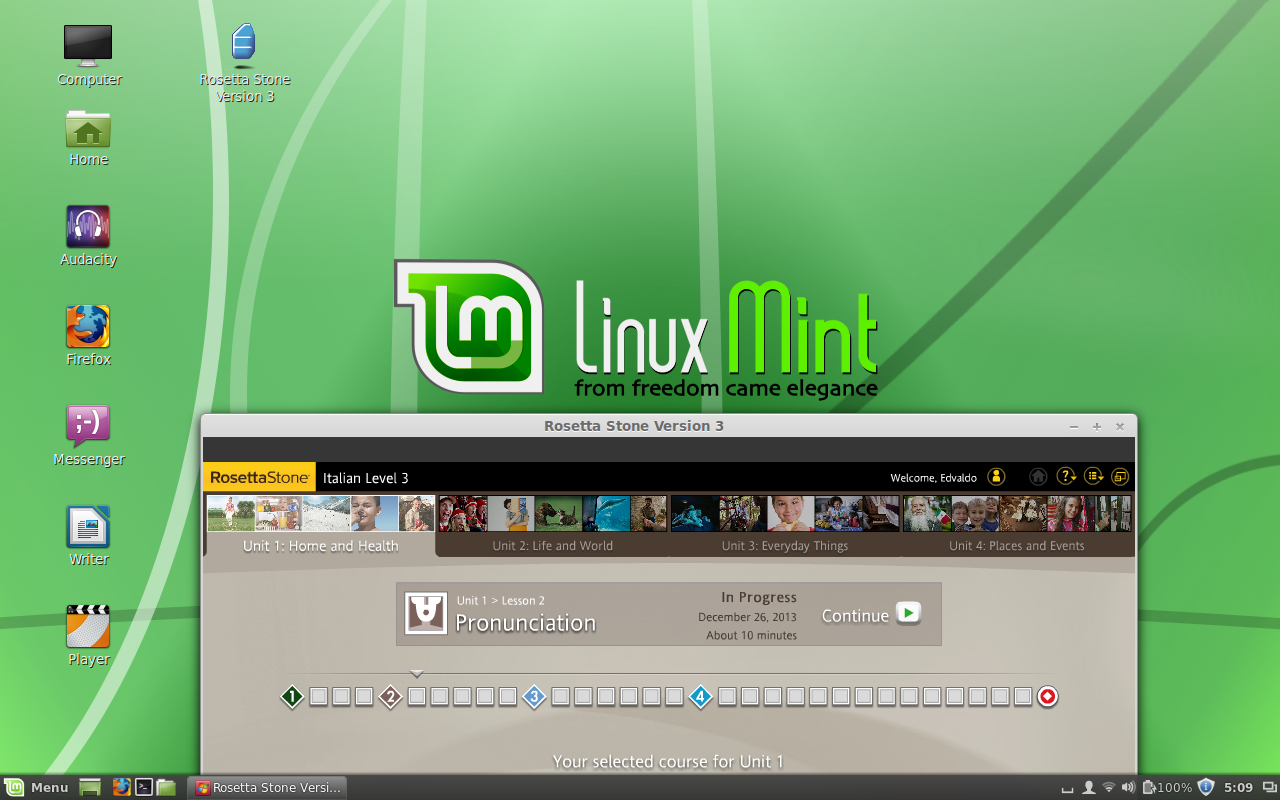
Rosetta Stone & Linux


Texto em Português mais abaixo. 
Scroll down for text in Portuguese.

Dear readers,
This post does not correspond to the main objective of this blog, which is to relate my study progress with Rosetta Stone. But due to the importance of this information, I decided to post it here.

One of the main reasons for me to keep using Microsoft Windows and not a Linux distro was that I couldn't use Rosetta Stone on Linux. I mean, the installation of Rosetta Stone on Linux should be easy with Wine (a software to run Windows programs on Linux). You simply need to have Wine installed, execute Rosetta Stone application and then install the language you want. So far, so good.... but then there is always this microphone issue: most users simply cannot make the microphone work on RS installed in Linux.


Since the solution for that is so hard to find, I decided to post this tutorial here.


HOW TO MAKE MICROPHONE WORK FOR ROSETTA STONE IN LINUX


I tried this in two computers with different Linux distros and in both it worked: Linux Mint 16 in a laptop and Ubuntu 13.10 in a desktop. I use Rosetta Stone 3.4.5 in both. I guess this should work for other versions of both Linux and RS. I found this tutorial here, which is originally for Ubuntu.

Solution came with the following settings:
1 – Install latest Wine 1.5.14

Open the terminal and paste these commands:
sudo add-apt-repository ppa:ubuntu-wine/ppa
sudo apt-get update
sudo apt-get install wine1.5

2 - Go to Configure Wine, in the tab 'libraries', enter 'winepulse.drv' in the box and click on add, click yes on the warning. Select winepulse.drv and change load order to 'disabled'.

3 - Try running Rosetta Stone and see if the problem was solved.
For me, two options of microphone appeared, any will do.


SOLVING POSSIBLE PROBLEMS

Speech recognition doesn't work

This may be caused because the quality of the microphone might be really bad inside Rosetta Stone under Wine specifically. In my case it has a lot of interference and noise, so the speech recognition did not work most of the time.

Solution: put the speech recognition in ¨easy mode¨ in RS settings, and set the input volume close to the minimum in Linux settings. 

1 -  Access "set preferences";
2 - Perhaps any microphone will do.
3 - Set to "easy". 
4 - Apply changes.

 
1 - Click on the volume icon on the bottom right of the Linux Mint screen or top right in Ubuntu. 
2 - access sound settings > input. 
3 - Set input volume close to the minimum.


The microphone option suddenly disappears in Rosetta Stone

Another frustrating problem was that sometimes when I opened Rosetta Stone, the microphone option was there... and other times it was not. It simply vanished into thin air. So I could just use the microphone if RS happened to recognize it. I realized this bug was caused by other programs or windows that were open on the background that might be ¨stealing¨ the microphone. For example, if I don´t close the window for the Linux sound settings, RS simply won´t see the microphone, like this:

Solution: close everything else before running Rosetta Stone.

I realized the two aforementioned problems in the computer running Linux Mint (perhaps because the computer is real old). In the computer with Ubuntu, Rosetta Stone ran smoothly.


TRANSFER YOUR PROGRESS FROM WINDOWS TO LINUX


If you have already been studying and don't want to lose all your progress report when you migrate to a new computer or system, all you need to do is to copy file tracking.db3 - that's where your progress is registered.

In Windows, this is the path:


 C:\ProgramData\Rosetta Stone\tracking.db3

Folder ProgramData is hidden, so in order to view it, you need to access Control Panel > Folder Options > View > "Show hidden files, folders and drivers."


In Linux, you need to access "Browse C: Drive" > Users > Public > Application Data > Rosetta Stone

Find C: drive...

In Ubuntu

In Linux Mint (Menu > Wine >  Browse C: Drive)


After finding file tracking.db3, delete it and substitute for the one that contains your progress.


Hope this is useful! Now study hard!
________________________________________________________________


Caros leitores,

Esta postagem foge um pouco do objetivo do blog, que é simplesmente relatar meu progresso com o Rosetta Stone. Mas devido à utilidade das informações, resolvi postar.

Um das principais razões por que eu continuava usando o Microsoft Windows em vez de alguma distribuição do Linux era que eu não conseguia usar o Rosetta Stone no Linux. Na verdade a instalação do Rosetta Stone no Linux deve ser bem fácil com o Wine (um software para rodar programas do Windows). Tudo o que você precisa é ter o Wine instalado, executar o aplicativo do Rosetta Stone e depois instalar o curso do idioma desejado. Até aí tudo bem... o problema é que a maioria dos usuários simplesmente não consegue fazer o microfone funcionar no RS instalado no Linux.

Já que a solução é tão difícil de encontrar, resolvi postar um tutorial aqui.


COMO FAZER O MICROFONE FUNCIONAR COM O ROSETTA STONE NO LINUX

Tentei os procedimentos em dois computadores diferentes: um com o Linux Mint 16 e outro com o Ubuntu 13.10. Funcionou em ambos. Uso o Rosetta Stone 3.4.5. Acredito que os procedimentos devam funcionar com outras versões do Linux e do RS. Encontrei este tutorial, que originalmente é para o Ubuntu.

A solução veio com as seguintes configurações:
1 – Instale a última versão do Wine 1.5.14

Abra o terminal e cole os seguintes comandos:
sudo add-apt-repository ppa:ubuntu-wine/ppa
sudo apt-get update
sudo apt-get install wine1.5

2 – No menu, vá para Wine > Configurar Wine> aba “bibliotecas¨ e digite 'winepulse.drv' na caixa e clique em adicionar, clique sim para o aviso. Selecione winepulse.drv, editar e marque em ´desativar´.

3 – Tente rodar o Rosetta Stone e veja se o problema foi resolvido.
Para mim, o programa mostrou duas opções de microfone. Qualquer opção funciona.


RESOLVENDO POSSÍVEIS PROBLEMAS

O reconhecimento de voz não funciona

Se isso acontecer, talvez seja porque a qualidade do microfone pode estar bastante ruim dentro do Rosetta Stone especificamente. No meu caso há muito ruído, de forma que impede o reconhecimento de voz.

Solução: na configuração do microfone no Rosetta Stone selecione o modo “fácil¨. Nas configurações de som do Linux, ajuste o volume do microfone para quase do mínimo. Siga as instruções:
 1 - Acesse "preferências".
2 - Qualquer microfone deve funcionar.
3 - Coloque em "fácil".
4 - Aplicar mudanças.

1 - Clique no ícone de volume no canto inferior direito da tela do Linux Mint, ou superior direito no Ubuntu.
2 - Acesse Configurações de som > EntMain#Homerada. 
3 - Coloque o volume quase no mínimo.

A opção de microfone desaparece do nada no Rosetta Stone

Um problema bastante frustrante que tive é que às vezes quando eu abria o Rosetta Stone, a opção de microfone estava lá... outras vezes não estava. Simplesmente sumia do nada. Então eu só podia usar o microfone quando o RS por acaso decidia reconhecê-lo. Eu descobri que esse bug é causado por outros programas e janelas que ficam abertas em segundo plano e podiam estar ¨roubando¨ o microfone. Por exemplo, se eu não fechar a janela de configuração de som do Linux, o RS simplesmente não vai ver o microfone, como mostra a figura:


Solução: feche tudo antes de abrir o Rosetta Stone.

Esses dois problemas apareceram no computador com o Linux Mint (talvez seja porque o computador é bem mais velho). No computador com o Ubuntu, o Rosetta Stone funcionou sem problemas.


TRANSFIRA SEU PROGRESSO DO WINDOWS PARA O LINUX

Se você já está estudando e não quer perder todo o registro do seu progresso quando migrar para outro computador ou sistema operacional, tudo o que precisa fazer é copiar o arquivo tracking.db3, pois é aí onde está guardado seu progresso.

No Windows, este é o caminho:
 C:\ProgramData\Rosetta Stone\tracking.db3

A pasta ProgramData é oculta, para visualizá-la você precisa acessar o painel de controle, opções de pasta, aba "modo de exibição"  e marcar "mostrar arquivos, pastas e unidades ocultas". Veja a imagem:


No Linux, você precisa acessar "Navegar no Disco C:" > Users > Public > Application Data > Rosetta Stone

Encontre o disco C:

No Ubuntu

No Mint (Menu > Wine >  Navegar no Disco C:)


Após encontrar o arquivo tracking.db3, apague-o e substitua por aquele que contém seu progresso.


 Espero que seja útil! Agora vamos estudar!

11 de novembro de 2013

LEVEL 3 FINISHED! – NÍVEL 3 CONCLUÍDO!

LEVEL CONCLUDED: 3
TYPE OF CURRICULUM: standard
OVERALL SCORE: 97%
TIME SPENT: 20 hours
Starting date: Nov 2, 2013
Finishing date: Nov 10, 2013
Number of days of study: 9 days
Total number of hours to complete the 3 levels: 62 hours (without any study review).


WHAT YOU WILL LEARN IN LEVEL 3

- Vocabulary related to: garden, kitchen, bathroom, dishes, sports, music, art, parts of the body, geography, parties, events, wedding, funeral, religion, feelings, animals, plants, money, traveling, languages, food, measurements and fractions, elections, news, politics, holidays, school...
- Indefinite pronouns: somebody, nobody, something, nothing...
- Verbs:
* Conditional: I would like... I would put...
* Subjunctive: It’s necessary that someone HELP... It’s important that he WIN.... If I HAD...
* Imperfetto (a form of the past tense that doesn’t exist in English): We USED TO LIVE... I USED TO PLAY...
* Past participle: has SAID... has READ... was DISCOVERED...
- Describing things with many more adjectives;
- Relating facts and describing actions that are a little more complex;
- Expressing quantity, frequency and intensity;
- Expressing thoughts, asking and giving opinions.


PRACTICAL RESULTS OF MY STUDY

What everyone wants to know: 
CAN I FINALLY SPEAK FLUENT ITALIAN? NO! 

Even so, I guess the results are satisfactory... after just one month of study and having finished level 3, I have the skills to at least hold a very basic conversation in Italian. I continue to watch documentaries, I listen and watch the news and now I started to read simplified texts. When I use Italian in these activities, I noticed that my comprehension was enhanced – I understand much more now comparing to level 2.  I can also ask for and give opinions, narrate facts, give suggestions, express some thoughts... in other words, level 3 provides all the language necessary for a simple social interaction – BUT I’M STILL FAR FROM FLUENT!

However, it’s important to point out that Rosetta Stone itself does not intend to make a learner reach an advanced level (that would mean fluency), but an intermediate level in fact (even after completing level 5). That’s what they claim in their website:

The Common European Framework of Reference for Languages (CEFR) establishes well-defined criteria to rate a learner’s language abilities as the following: A (basic), B (intermediate) and C (advanced).

So according to the table in Rosetta Stone website, upon completion of level 3, I would have reached level A2 and would be opening the door to level B1.

To prove that, nothing better than putting it to test!

TEST RESULTS
Each test has 30 questions. Here are my results:

Congratulations! Your Italian is at level A1 !
You solved 25 questions.
Your percentage is 83 %.

Congratulations! Your Italian is at level A2 !
You solved 21 questions.
Your percentage is 70 %.

Sorry, you did not reach level B1.
You solved 12 questions.
Your percentage is 40 %.
You need 70% to complete with this level.
Your Italian is at level A2

It’s confirmed: my level is A2, entering B1.

It’s important to point out that I took these tests without any further study and without any kind of review. I didn’t study specifically to take the test nor did I cheat with google translator :P  . What I’ve done so far is to follow the course straight and raw according to the “standard curriculum”. 70% is not great, but I guess with some review I could have done better.


How long does it take to reach level A2?

Of course that depends on a lot of factors: language being studied, native language of the learner, commitment, motivation, method, etc...
Take a look at what some well-know institutions say:
Deutsche Welle –  150-225 hours
Cambridge ESOL – 180-200 hours
Alliance Française – 160-200 hours


CONCLUSION

I reached level A2 with 62 hours of study with Rosetta Stone. I would be able to hold a simple conversation and I can understand most things when I watch the news, documentaries and read some simplified texts.

I don’t want to imply that 62 hours of study with Rosetta Stone is equivalent to 200 hours with the methods listed above. Such a comparison, to be prudent, could just be made with careful scientific investigation.  What I can state is that this result indicates that those claims  that Rosetta Stone is ineffective do not correspond entirely to real facts.

_________________________________________

NÍVEL CONCLUÍDO: 3
TIPO DE CURRÍCULO: standard
PONTUAÇÃO GERAL: 97%
TEMPO GASTO: 20 horas
Data de início: 02 Nov 2013
Data de término: 10 Nov 2013
Número de dias de estudo: 9 dias
Tempo total de estudo dos 3 níveis: 62 horas (sem fazer revisão).


O QUE SE APRENDE NO NÍVEL 3

- Vocabulário relacionado a: jardim, cozinha, banheiro, louças, esportes, música, arte, partes do corpo, geografia, festas, eventos, casamento, funeral, religiões, sentimentos, animais, plantas, dinheiro, viagem, línguas, alimentos, medidas e frações, eleições, notícias, política, férias, escola...
- Pronomes indefinidos: alguém, ninguém, algo, nada...
- Verbos:
* Condicional: Você deveria... gostaria... colocaria...
* Subjuntivo: Precisamos de alguém que nos AJUDE... É provável que aquele time VENÇA. .. Se eu TIVESSE...
* Pretérito imperfeito: Não SABIA... MORÁVAMOS na Rússia...
* Particípio: tem DITO, tem LIDO, foi DESCOBERTO, etc...
- Descrever coisas com adjetivos mais variados.
- Narrar fatos e descrever ações um pouco mais complexas.
- Expressar quantidade, frequência, intensidade.
- Expressar pensamentos, pedir e dar opiniões.


RESULTADOS PRÁTICOS DO MEU ESTUDO

O que todos querem saber: 
ESTOU FALANDO ITALIANO FLUENTE? NÃO! 

Mesmo assim creio que os resultados foram satisfatórios... depois de apenas um mês de estudo e terminado o nível 3, eu já tenho habilidade para ao menos manter uma conversa bem básica na língua italiana. Continuo vendo documentários, ouço e assisto às notícias e agora comecei a ler alguns textos simplificados. Quando uso a língua nessas atividades, percebo o quanto minha compreensão melhorou – entendo muito mais agora comparando com o nível 2. Também consigo pedir e exprimir opiniões, narrar fatos, dar sugestões... enfim o nível 3 proporciona a linguagem necessária para uma interação social mais simples – MAS ISSO ESTÁ LONGE DA FLUÊNCIA.

No entanto, é importante ressaltar que o Rosetta Stone por si não se propõe a fazer com que o aluno alcance o nível avançado (o que significaria fluência), mas sim o nível intermediário (mesmo após o término do nível 5), conforme está no próprio site.

A escala do Quadro Europeu Comum de Referência para as Línguas estabelece critérios bem definidos para classificar os níveis de habilidade linguística em A (básico), B (intermediário) e C (avançado).

Então de acordo com a tabela no site do Rosetta Stone, ao término do nível 3 eu teria alcançado o nível A2 e estaria entrando no B1.

Para provar isso, nada melhor que uma prova!


RESULTADO DOS TESTES
Cada teste possui 30 questões. Aqui estão meus resultados:

Congratulations! Your italian is at level A1 !
You solved 25 questions.
Your percentage is 83 %. 

Congratulations! Your italian is at level A2 !
You solved 21 questions.
Your percentage is 70 %.

Sorry, you did not reach level B1.
You solved 12 questions.
Your percentage is 40 %.
You need 70% to compelete with this level.
Your Italian is at level A2 

Está confirmado, meu nível é A2, entrando no B1.

É importante ressaltar que eu fiz esses testes sem nenhum estudo adicional e sem nenhum tipo de revisão. Eu não estudei para fazer as provas nem consultei o google translator :P . Tudo o que fiz até agora foi seguir o curso conforme o currículo “standard”. 70% não é ótimo, mas creio que com uma revisão eu teria ido melhor.


Quantas horas de estudo são necessárias para se alcançar o nível A2?

Claro que isso depende de vários fatores: língua estudada, língua nativa do estudante, empenho, motivação, método, etc...
Veja o que dizem instituições renomadas:
Deutsche Welle –  150-225 horas
Cambridge ESOL – 180-200 horas
Alliance Française – 160-200 horas


CONCLUSÃO

Alcancei o nível A2 com 62 horas de estudo com o Rosetta Stone. Eu conseguiria manter uma conversa simples e consigo acompanhar as notícias, documentários e alguma leitura.
Não quero sugerir que 62 horas de estudo do Rosetta Stone equivalem a 200 horas com os métodos citados acima. Para se fazer essa comparação seriam necessários estudos científicos mais criteriosos.  O que posso afirmar é que esses resultados indicam que as afirmações de que o Rosetta Stone é ineficiente não correspondem ao todo com os fatos.

3 de novembro de 2013

LEVEL 2 FINISHED! – NÍVEL 2 CONCLUÍDO!

LEVEL CONCLUDED: 2
TYPE OF CURRICULUM: standard
OVERALL SCORE: 97%
TIME SPENT: 17 hours

So... I started level 2 on Oct 24 and finished it on Nov 1st. I skipped one day, that is a total of 8 days of study. An average of  2h15min a day.


 WHAT YOU WILL LEARN IN LEVEL 2

Skills:
- Using words that refer to: post-office, museum, library, theater, movies, hotel, school, hospital, gas-station, supermarket, food, means of transportation, airport, church, etc.
- Asking for directions;
- Talking to desk-clerks at the airport;
- Ordering food at a restaurant;
- Shopping;
- Talking about the time, months;
- Talking about nature and its elements (tree, forest, mountain, beach, rain, snow, sun, wind, heat, cold, etc.);
- Talking about physical activities, sports, running, walking, camping;
- Describing actions in the past, present and future;
- Making comparisons with some adjectives;
- Talking about studies and some areas of human knowledge: science, art, math, music, history, etc.
- Talking about work (employee, director, etc.);
- Talking about parties, events, invitations;
- Asking for help and apologizing;
- Saying what you want, would like, need, what you’re looking for, what you can do, etc.


PRACTICAL RESULTS OF MY STUDY
About all these skills, if you ask me to demonstrate some of them, I will have to stop and think carefully before saying anything, and probably I’ll make a lot of mistakes. This part is still very weak.

BUT WHAT MADE ME REALLY IMPRESSED IS MY ABILITY TO UNDERSTAND ITALIAN! Now I can watch documentaries and the news in Italian with ease and I can honestly say I can understand more then half of what they are saying! Of course we native speakers of Portuguese have the upper-hand in the fact that Italian has a lot of similarities with our own language (in a way that we are able to understand Italian to some extent even without ever studying it). But what helped me a lot was the comprehension of functional words such as prepositions, conjunctions, articles, pronouns, adverbs, etc. (and we do have to study to understand that!). While watching the news and documentaries, I could recognize many of the words I saw in the course, that really impressed me.
When I get bored of the lessons, I watch videos in the Euronews website or some documentary:

CONCLUSION
Perhaps I would be able to handle a very primitive dialogue in Italian, making a lot of mistakes, but there would be no way to express my thoughts or give opinions related to more complex things. The positive aspect was the development of my listening comprehension (that made me satisfied with the result). I’ve studied 42 hours so far – for a language, that’s still very little time.

_____________________________________________

NÍVEL CONCLUÍDO: 2
TIPO DE CURRÍCULO: standard
PONTUAÇÃO GERAL: 97%
TEMPO GASTO: 17 horas
Curso completo num total de 8 dias, média de cerca de 2h15min por dia.

Então... comecei o nível 2 no dia 24/10, terminei ontem, dia 01/11. Fiquei um dia sem estudar, então no total foram 8 dias de estudo.


O QUE SE APRENDE NO NÍVEL 2

Habilidades:
- Usar algumas palavras referentes a: correio, museu, biblioteca, teatro, cinema, hotel, escola, hospital, posto de gasolina, supermercado, alimentos, meios de transporte, aeroporto, igreja, etc.
- Pedir informações;
- Conversar com atendentes no aeroporto;
- Dar instruções a um taxista;
 - Fazer reservas;
- Pedir um quarto de hotel;
-  Fazer pedidos em restaurantes;
- Fazer compras;
- Falar sobre horas, meses;
- Falar sobre a natureza e seus fenômenos (árvore, bosque, montanha, praia, chuva, neve, sol, vento, calor, frio, etc.);
- Falar sobre atividades físicas, esportes, corrida, caminhada, acampamento;
- Descrever ações no passado, presente e futuro;
- Fazer comparações com alguns adjetivos;
- Falar sobre estudos e algumas áreas do conhecimento: ciência, arte, matemática, música, história, etc.
- Falar sobre trabalho (empregado, diretor da empresa, etc.)
- Falar sobre festas, espetáculos, fazer convites;
- Pedir ajuda, desculpas;
- Dizer o que você deseja, gostaria, necessita, o que você procura, o pode fazer, etc.

RESULTADOS PRÁTICOS DO MEU ESTUDO
Sobre todas essas habilidades, se você me pedir pra demonstrar alguma delas, vou ter que parar pra pensar antes de falar e provavelmente vou cometer muitos erros. Essa parte ainda é bem precária.

MAS O QUE ME DEIXOU BASTANTE IMPRESSIONADO FOI MINHA CAPACIDADE DE COMPREENDER ITALIANO! Posso agora assistir a documentários e às notícias em italiano com tranquilidade e posso dizer com segurança que consigo entender bem mais da metade do que estão dizendo! Claro que existem muitas palavras parecidas com o português (de modo que um brasileiro vai entender algo sem nunca estudar italiano), mas o que ajudou bastante foi a compreensão de palavras “funcionais” como preposições, conjunções, artigos, pronomes, advérbios, etc. Ao ver as notícias ou documentários, consegui reconhecer muitas palavras que estudei no curso, isso me impressionou bastante.
Quando me canso das lições, o que tenho feito é assistir a vídeos na página da Euronews ou algum documentário:

CONCLUSÃO
Eu até iria conseguir travar um diálogo bem primitivo na língua, cometendo vários erros, mas não teria jeito de expressar meus pensamentos e dar opiniões em relação a coisas mais complexas. O ponto positivo foi o desenvolvimento da minha capacidade de compreensão (isso me deixou satisfeito com o resultado). Até agora foram 42 horas de estudo – para uma língua isso ainda é bem pouco.